Tuesday, March 6, 2007

Mitt Romney 2008: America's first Mormon president? The New England Republican who might make it so.

By Jonathan Darman
Newsweek
Dec. 25, 2006 - Jan. 1, 2007 issue - In late October, departing Massachusetts Gov. Mitt Romney huddled with a godly group. Gathered in his kitchen were 15 of the country's leading evangelicals, including giants like Jerry Falwell, Franklin Graham and Richard Land of the Southern Baptist Convention. They'd come to nibble sandwiches, slurp soup and quiz Romney on his faith. Why on earth should they support Romney, a Mormon, in his presidential candidacy in 2008? Richard Lee, a Baptist minister from Cumming, Ga., got to the heart of the matter. What did Romney really believe about Jesus Christ? Romney didn't hesitate. "When I say Jesus Christ is my Lord and savior, I realize that means something different to you than it does to me," he admitted. But he urged them to remember their shared beliefs: the faith that Christ was born of a virgin, was crucified and rose after three days. The ministers were pleased. "So you're really a Baptist?" Lee cracked.

Romney, an unannounced but eager candidate for the Republican nomination, is hoping other evangelicals will have trouble telling the difference. With the Iowa caucuses only a year away, he is working tirelessly for the support of Christian conservatives. In another year, this might be a futile quest given many evangelicals' conviction that Mormonism is a heretical cult. (Unlike evangelicals, Mormons believe Jesus appeared in America after his resurrection and that God himself was once a man.) And the recent resurfacing of a letter Romney wrote expressing solidarity with gay-rights groups has many social conservatives wondering if a governor from Massachusetts is "700 Club" material.

But then there are the alternatives. GOP front runners John McCain and Rudy Giuliani are not beloved by the religious right. Arkansas Gov. Mike Huckabee and Kansas Sen. Sam Brownback speak the language of evangelicals but have negligible name recognition nationwide. Some Christian conservatives have watched Romney's passionate opposition to gay marriage in Massachusetts and concluded he may be the one electable candidate who shares their principles in public and private life. "In terms of values," says Mark DeMoss, a Christian media strategist who has helped Romney reach out to evangelicals, "I have more in common with most Mormons than I do with a liberal Southern Baptist."

Monday, March 5, 2007

Poll: Insiders favor Clinton, Romney in 2008 : Party officials' opinions about presidential candidates often shape the race. Deep partisan divisions r

By Mark Z. Barabak
Times Staff Writer
Published March 4, 2007


Democrat Hillary Rodham Clinton and Republican Mitt Romney have emerged as the leading presidential favorites among party insiders, according to a new Los Angeles Times poll, which found deep partisan divisions over the country's direction and top issues in the 2008 campaign.

The survey showed former Sen. John Edwards of North Carolina in second place among Democratic Party leaders, ahead of Sen. Barack Obama of Illinois. It pointed up danger signs for Sen. John McCain of Arizona, who trailed former Massachusetts Gov. Romney and former New York City Mayor Rudolph W. Giuliani, the leader among Republicans in national voter surveys.

It also signaled GOP concerns about holding the White House for an additional four years — 42% of party leaders said it would be tougher to elect a Republican after eight years under President Bush, and just more than half said the GOP nominee should campaign on moving the country in a new direction.

"I love President Bush — I really do," Cindy S. Phillips, a Republican national committeewoman from Mississippi who is looking hard at Giuliani, said in a follow-up interview. "But you can't be the same as the person before you. You have to bring your own touch, your own ideas."

The poll surveyed members of the Democratic and Republican national committees, the governing bodies of the two major political parties. Though relatively few, these insiders could have an important role in deciding which of their candidates face each other in November 2008, thanks to the influence many wield in their states.

"The DNC and RNC members are not just delegates" to the national nominating conventions, said Charles Cook, a nonpartisan campaign analyst in Washington. "They are key organizers and opinion leaders. They can help build or kill a groundswell, make a candidate's challenge in a state easier or much harder. They matter a lot."

The poll also offers a different reading of sentiments than national voter surveys, which tend to be heavily influenced by name recognition at this early stage of the campaign.

A similar poll of DNC members about four years ago found significant backing for Sen. John F. Kerry of Massachusetts as well as surprising support for Edwards and former Vermont Gov. Howard Dean — at a time when the latter two made comparatively weak showings in voter surveys. The three ended up as the top contenders for the Democratic nomination, won by Kerry.

The Times Poll, directed by Susan Pinkus, interviewed 313 of 386 DNC members and 133 of 165 RNC members from Feb. 13-26. Since the poll attempted to interview current state members of each organization rather than a random sample, there is no margin of error.

The survey found no candidate enjoying a lock on institutional support. To the contrary, more than 1 in 3 RNC members had no favorite; just under 1 in 3 DNC members had no preference.

Among Republicans, Romney had the most backing among party insiders, with 20% support, followed by Giuliani with 14%, McCain with 10% and former House Speaker Newt Gingrich of Georgia — who has said he might enter the race in the fall — with 8%.

In a potentially worrisome sign for McCain, just over 1 in 10 RNC members said they would not support him if he won the party's nomination in his second attempt.

"It shows just how much resistance there is within the Republican establishment to McCain and how open the party is to candidates who either aren't very conservative, like Giuliani, or only recently minted conservatives, like Romney," Cook said. "McCain has worked pretty hard since 2000 to be a team player, but these numbers would suggest that there is still a problem for him."

Among Democrats, Sen. Clinton of New York had the backing of 20% of party leaders, followed by Edwards with 15%, Obama with 11%, former Vice President Al Gore — who is not in the race — with 10%, and New Mexico Gov. Bill Richardson with 9%.

Regardless of whom the insiders supported, Giuliani and Clinton were each rated their party's strongest prospective nominee with the best shot at winning the White House.

The insiders were divided over their most important criterion for backing a candidate. Just over a third of Republicans said issues were the most important factor. Nearly 4 in 10 Democrats said the most important factor was a candidate's chance of winning the White House.

The survey turned up a dramatic split over the direction of the country and the problems the presidential candidates should address.

Whereas 83% of Republicans said the country was on the right track — and all said the economy was doing well — 95% of Democrats said the country was headed the wrong way, and more than 6 in 10 said the economy was in bad shape.

Not surprisingly, partisans were also worlds apart over the war in Iraq, with the overwhelming majority of Republicans supporting Bush's policies and Democrats nearly unanimous in their opposition.

There was less agreement among Democrats over an exit strategy. Just over half of DNC members favored legislation requiring Bush to begin withdrawing U.S. troops; 17% favored the more dramatic step of cutting off funding. About 2 in 10 Democrats said Bush should not be required to withdraw troops.

Sunday, March 4, 2007

The Best Choice Is Also a Good Choice: Why social conservatives should support Mitt Romney for president.

By James Bopp Jr.

It would be foolish to imagine that social conservatism can achieve any significant success without a president who strongly supports social conservative positions. The reason for this lies primarily in the president’s power to appoint judges. Social policy in America has been largely shaped by the federal judiciary, which has imposed an unrelenting liberal agenda on a reluctant people. The law, as it concerns the issues of abortion, religious freedom, pornography, gay rights, sexual license, family, and marriage, has been shaped and even determined by judicial fiat. Presidential leadership is vital to reversing these affronts.

There is no doubt that Governor Mitt Romney is running unabashedly as a pro-life and pro-family candidate for president and that he wants Roe v. Wade overturned. But his sincerity is being questioned because, as he has acknowledged, he has changed his mind on these issues. In 1994, in his race against Teddy Kennedy for the U.S. Senate, and in his 2002 race for governor of Massachusetts, Romney was pro-choice on abortion. So it is right to question him about the sincerity of his conversion.

Romney’s conversion was less abrupt than is often portrayed. In his 1994 Senate run, Romney was endorsed by Massachusetts Citizens for Life and kept their endorsement, even though he declared himself to be pro-choice, because he supported parental-consent laws, opposed taxpayer-funded abortion and mandatory abortion coverage under a national health insurance plan, and was against the Freedom of Choice Act, which would have codified Roe v. Wade by federal statute. In 1994, NARAL’s Kate Michelman pronounced him a phony pro-choicer. “Mitt Romney, stop pretending,” she demanded. “We need honesty in our public life, not your campaign of deception to conceal your anti-choice views,” she said. Some conservative Boston newspaper columnists view it similarly. As Jeff Jacoby of the Boston Globe put it: “Romney’s very public migration rightward over the last few years is . . . intended not to hide his real views but to liberate them. In 1994, Romney struck me as an extraordinarily bright, talented, and decent man — and a political neophyte who fell for the canard that the only way a conservative could win in Massachusetts was by passing for liberal.”

In 2001, Romney said, in a letter to the Salt Lake Tribute, that he believes that “abortion is the wrong choice, but under the law it is a choice people have.” And in the 2002 governor’s race, Romney made clear that “on a personal basis, I don’t favor abortion,” that he opposed lowering the age at which minors could obtain abortions without parental consent to 16, and that he supported a ban on partial-birth abortions, but that, as governor, he would “protect the right of a woman to choose under the law of the country and the laws of the commonwealth.” As one Boston commentator observed, Romney’s “abortion statements sound as much like someone trying to wrestle with the issue as someone trying to weasel his way out of it.”

Romney now says that he was wrong about abortion in those years, that his position has “evolved and deepened” as governor, and that he is “firmly pro-life.”

The evaluation of Romney’s conversion needs to be considered in light of the pro-life movement’s consistent effort over the years to educate, and thereby convert, people to the cause. The pro-life movement has aggressively promoted conversion and has achieved great success in doing so. Today, for the first time since Roe v. Wade, a majority of Americans identify themselves as pro-life, and many of these are converts, some who have even had abortions themselves. Ronald Reagan and George H. W. Bush, both pro-life presidents, were converts. In 1967, Reagan, as governor of California, signed into law the nation’s most permissive abortion law, and, in 1980, Bush ran as an unabashedly pro-choice candidate. Both were unswerving in their support for the pro-life position as president, and Reagan’s ability and willingness to articulate the pro-life position was invaluable.

Yet how is the sincerity of a conversion to be measured? There are two salient considerations in this regard: first, some defining moment that prompted a change of heart; second, the fact that deeds speak louder than words. Romney’s conversion exhibits both. First, Romney has had a life-changing event. It was when he was governor and researchers were proposing embryonic cloning at Harvard. As he recounts it, one of the researchers said that there “wasn’t a moral issue, because . . . they destroy the embryos at 14 days.” Romney said that “it struck me that we have so cheapened the value of human life in this country through our Roe v. Wade decision that someone could think that there is no moral issue to have racks and racks of living human embryos and then destroying them at 14 days.”

This was not a trivial matter for Romney and his family. As he told the New York Times at the time, “My wife has MS and we would love for there to be a cure for her disease and for the diseases of others. But there is an ethical boundary that should not be crossed.”

And Romney, as governor, acted on these convictions. He vetoed an embryonic cloning bill; he vetoed a bill that would allow the “morning after pill” to be acquired without a prescription on the grounds that it is an abortifacient; he vetoed legislation which would have redefined Massachusetts longstanding definition of the beginning of human life from fertilization to implantation; and he fought to promote abstinence education in the classroom. One should not underestimate the tremendous political price that Governor Romney paid in Massachusetts for these acts. Both conviction and courage are necessary for effective pro-life leadership, and Romney, in office, displayed both.

These actions as governor have lead leaders of the most important social conservative groups in Massachusetts, including Massachusetts Citizens for Life, Massachusetts Family Institute, and the Knights of Columbus, to observe that, while previous comments by Romney “are, taken by themselves, obviously worrisome to social conservatives including ourselves, they do not dovetail with the actions of Governor Romney from 2003 until now — and those actions positively and demonstrably impacted the social climate of Massachusetts.” They conclude that Romney “demonstrat[ed] [his] solid social conservative credentials by undertaking” these actions, and has therefore “proven that he shares our values, as well as our determination to protect them.”

Many social conservatives do not share Romney’s Mormon faith, but his faith should be viewed by social conservatives as a good sign, not as a matter of concern. The Mormon religion, while having tenets that Christians do not share, is profoundly conservative in its support for life, family, and marriage. Thus, Romney’s religion reinforces, rather than conflicts with, his conversion. All people of faith believe that the best public officials are those with God, not man, at the center of their lives.

It cannot be forgotten, however, that this is also a political question, a matter of practical choices. And what are these choices? Senator John McCain and Mayor Rudy Giuliani are the other leading candidates for the Republican nomination. Barring the unlikely emergence of some conservative alternative in the next few months, the choice will be between Giuliani, McCain, and Romney. While both Giuliani and McCain would be vastly superior to any of the prospective Democrats, there are serious questions about the policy positions of both, and not just on social conservative issues.

Giuliani is simply not a social conservative. He is pro-choice, pro-partial birth abortion, and pro-special rights for homosexuals. He is also pro-gun control. Senator McCain opposes the federal marriage amendment, supports embryonic stem-cell research, and was a ringleader of the Gang-of-14 compromise that made it easier for Democrats to block President Bush’s judicial nominees. Also, he is the principal sponsor of the McCain-Feingold bill, which imposes severe limits on the participation of citizens groups and political parties in our representative democracy.

It is unlikely that there will be any social conservative in this race to rival Giuliani and McCain other than Governor Romney. And Romney’s record on other conservative issues is impressive as well. He has demonstrated his administrative ability in successfully managing a variety of organizations in the private (his venture-capital firm), the nonprofit (Salt Lake City Olympics), and the public (as governor) arenas. Romney’s views on economic and foreign affairs are thoroughly conservative, his ability to effect them is enviable, and, just as importantly, his skill at articulating them is superb.

Whatever one thinks about Romney’s conversion, and I believe it is sincere, the fact remains that Romney opposes public funds for embryo-destructive research that McCain and Giuliani support. Romney has fought for a federal marriage amendment and McCain and Giuliani oppose one. There is the simple question of whether social conservatives want someone who is currently on their side or someone who currently opposes them.

— James Bopp Jr. is a lawyer who focuses on nonprofit corporate and tax law, on campaign finance and election law, and on life issues. He most recently joined the Romney Presidential campaign as a special adviser on life issues, an unpaid position.

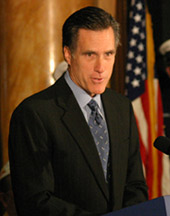
Romney stresses family values

JASON SPENCER, Staff Writer
Published February 23, 2007

People, not government, are the source of America's strength, Republican presidential hopeful Mitt Romney told a crowded room in Spartanburg late Thursday.

"There is no place that is more important to the future strength of America than the American home," Romney told a crowd of more than 600 people at the Spartanburg County Republican Party's annual Presidents Day Banquet.

"The work that goes on within the walls of a home is the most important work that is ever done in America. … And if we want to strengthen America, we need to strengthen the American family."

Romney's speech stressed family values, the need to cut off investments in businesses linked to the Iranian regime and the Republican belief in less government.

The former Massachusetts governor graced the stage at the downtown Marriott with his usual charisma, though his speech -- which was unscripted -- wasn't tied to a single theme as it has been at past Spartanburg engagements.

Romney admitted the United States didn't have enough planning and preparation, or enough troops, to handle Iraq after the fall of Saddam Hussein. But he stressed that over the next decade, America will need to concern itself more with Iran.

Romney sent a letter Thursday to

the New York state comptroller urging him to pull pension investments out of companies linked to Iran: "We want to squeeze pressure on that country and get them on the right track."

He criticized Democratic presidential hopefuls Hilary Clinton and John Edwards for wanting to engage and negotiate with Iran, saying that such a stance showed "a lack of understanding, and a certain timidity in dealing with someone who is doing something very, very bad. You don't want to reward bad behavior."

Romney talked about securing the U.S. border, energy independence and making sure "people get married before they have babies."

Romney talked about faith and values, but not his faith. He is a Mormon, which some Christians consider to be a cult.

It's unclear how Romney's personal beliefs will affect his performance in South Carolina.

"I'm here to find out who he is, what he believes in," the Rev. Chuck Bridges, pastor of Washington Avenue Baptist Church in Greenville, said beforehand.

"If people are looking at his moral stance, and not for him to be pastor for the country… If he has conviction, and moral fiber, and stands up for what's right, I could support him."

Bridges was at a table of 10 Upstate pastors, compliments of Greenville activist Dee Benedict, an evangelical who is active in GOP politics.

"He's probably the least flawed" of all the Republican presidential candidates, said Spartanburg County GOP Treasurer Bill May, who until this week had not decided on which man to get behind.

"If he can get past the Mormonism, I think he can carry it across the board. The Mormon religion is not well respected across the Bible Belt -- and you're talking to a Catholic here. But he's the one I'm going to support.

"I disagree with Mormonism, and I disagree with Baptists, too. But we're all brothers and sisters in Christ."

Romney's strategy has been to emphasize that he is a person of faith and that he shares the belief with Christians that Jesus Christ is the cornerstone of that faith.

In an interview with the Herald-Journal on Thursday, he said that people want a leader who is a person of faith, but that those people won't distinguish between different brands of faith.

It's enough for some.

"He's a true conservative, an innovative thinker, a visionary," said Celia Anderson Crosby, of Spartanburg.

But not everyone was sold on Romney.

"He's OK. His Mormonism doesn't bother me. But (Rudy) Giuliani looks like a much more credible candidate," said Allen Rawley of Spartanburg.

"Am I betraying my pro-life position by voting for Giuliani? No. It's a matter of saving our country. Yes, abortion is a top issue for me, but we've got to save our country or else it's a moot point."

U.S. Sen. Jim DeMint, R-S.C., introduced Romney. He praised Romney, whose candidacy he has endorsed, as someone who could manage this country's "huge, wasteful federal government."

"Washington is full of talk," DeMint said.

"But … talk makes no sense when you're not getting anything done. We need someone who understands that it's the results we're after. And we need a president who understands that the strength of America is not in Washington, D.C. -- it's in our people, it's in our churches, it's in our businesses. It's in thousands of volunteer associations all across this country that make our country better every day, and if our government could just get out of the way, America all by itself would just become greater and greater."

The night was centered on Romney, complete with Olympic music and a South Carolina-themed pillow presented to his wife, Ann, as a housewarming gift for their new home on Pennsylvania Avenue. Ann Romney spoke briefly about how she and Mitt were high school sweethearts and that "even then, I saw great things in him."

June Bond, a top aide in the Spartanburg County Republican Party and one of Romney's two county point people, emceed the event, which raised about $10,000 for the local GOP.

"This is a good crowd," said state Republican Party Chairman Katon Dawson, just before dinner. "Team Spartanburg up here knows how to treat candidates. And right now, Spartanburg has been the gateway to presidential politics in South Carolina."

Jason Spencer can be reached at 562-7214, or jason.spencer@shj.com

Excerpts From Governor Mitt Romney's Remarks At CPAC

FOR IMMEDIATE RELEASE
CONTACT: Kevin Madden (857) 288 - 6390

Today, Governor Mitt Romney will make remarks at the 34th Annual Conservative Political Action Conference (CPAC). Below are key excerpts of Governor Romney's remarks as prepared for delivery.

Governor Romney On The State Of Conservatism:

"Conservatism is alive and well. And it is needed more than ever. America faces a new generation of challenges, critical challenges. Today is similar in many respects to what we faced as a nation 30 years ago, looking at the menacing face of communism.


"In fact, 30 years ago, in this very conference, one man stood up and told America what was needed. It was conservatism, a new coalition of conservatives that would lead to a brighter future for the nation. Ronald Reagan said this: 'What I envision is not simply a melding together of the two branches of American conservatism into a temporary uneasy alliance, but the creation of a new, lasting majority.' And here is where he said that this conservative alliance would lead: 'I have seen the conservative future, and it works.'"

...

"It is the conservative coalition represented here that can build a brighter future for America: economic conservatives, social conservatives, and national security conservatives."

Governor Romney Calls For Repeal Of McCain-Feingold:

"To me, a fundamental principle of democracy is at stake. It is the people who are sovereign in America, not a few folks in black robes. Judges add things that aren't in the Constitution, and they take away things that are in the Constitution. In that regard, they let the campaign finance lobby take away First Amendment rights. If I'm president, I will fight to repeal McCain-Feingold."

Governor Romney On The Need To Restrain Spending:

"As you know, I'm proud to be the first Presidential candidate to sign Grover Norquist's tax pledge. But I have another pledge I am making to you today. If I am elected President, I will cap non-defense discretionary spending at inflation minus 1 percent. That alone will save $300 billion over 10 years. If Congress sends me a budget that exceeds the cap, I will veto that budget. I don't care if it's a Republican or Democrat Congress, I will veto that budget.

"And I know how to veto. I like vetoes. I vetoed hundreds of spending appropriations as Governor. And, by the way, if Congress doesn't want to do the cutting itself, then give me the same line item veto I had as governor.

"And one more thing, I will personally lead a top to bottom review of government programs, agencies, procurement and spending. It's time to cut out the mountains of waste and inefficiency and duplication in the federal government. I've done that in business, I've done that in the Olympics, and I've done that in Massachusetts. And boy, I can't wait to get my hands on Washington."

Governor Romney Calling Upon The Strength Of The American People:

"If we are to keep America strong, we must turn to the source of America's strength. Liberals think that government is the source of our greatness. They're wrong. The American people are the source of our strength: hard working, educated, skilled, family-oriented, willing to sacrifice for their family and their country, God-fearing, freedom-loving American people. They always have been the source of our strength and they always will be."

...

"Thirty years ago, in challenging times, a great coalition was forged in these halls. Today, we face a new generation of challenges.

"If we in this room lock our arms together, we can forge the political will to rebuild our military might. If we in this room will simply march forward we can propel America's growth and prosperity to lead to the world. If we in this room lift up our eyes, we will lift the spirit of the nation.

"Now is the time, this is the place, for us to stand together, to lead a great coalition of strength, for our families, for our future, for America. May God bless this great land."

Romney Pleads for Coalition of Strength

March 02, 2007

ABC News' Tahman Bradley Reports: Speaking at the Conservative Political Action Conference, former Gov. Mitt Romney R-Mass., made an appeal to conservative activists to join him in a movement to strengthen America's economy, military and families.

"If we are to keep America strong, we must turn to the source of America's strength…the American people are the source of our strength: hard working, educated, skilled, family-oriented, willing to sacrifice for their family and their country….they have always been the source of our strength and they always will be," he said.

Romney talked up his record of cutting taxes while governor of liberal Massachusetts and said it is time for "economic conservatism" in Washington. Romney, who was the first 2008 presidential candidate to sign the Grover Norquest anti-tax pledge, promised to cap non-defense discretionary spending at inflation minus one percent.

"If Congress sends me a budget that exceeds the cap, I will veto that budget. I don't care if it's a Republican or Democrat Congress, I will veto that budget, " Romney said.

Hoping to easy concerns among social conservatives about his recent change on a range of social issues like abortion, Romney said America faces unprecedented challenges, "this isn't the time for us to shrink from conservative principals."

Although the former governor made it known that he is standing behind President Bush's troop surge in Iraq saying the U.S. "shouldn't let Nancy Pelosi and Harry Reid dictate our battle strategies to the commanders in the field and the commander-in-chief," Romney laid out his belief that there is another component to winning the global war on terrorism. He said he hoped to bring together moderate Muslim governments and nation's in an effort to modernize the Muslim world and defeat "radical jihad."

"It's the Muslim people themselves who will have to eliminate radical jihad," he said.

Friday, March 2, 2007

Romney Takes on McCain's Marriage Amendment Position

The Brody File

David Brody
CBN News Capitol Hill Correspondent

March 1 2007

During the interview, Romney told me that he's the biggest defender of traditional marriage and distanced himself from John McCain on this issue. How is this going to play with grassroots conservative groups and inside the McCain camp? Is Brian Camenker from Mass Resistance running for his heart medication right about now? (it's in the upper left draw in the kitchen) They have taken issue with Romney in the past on this saying he could have done a whole lot more to prevent gay marriage in Massachusetts. The Romney campaign says Governor Romney did as much as he could really do under the law. I can read the emails now. Comments? Watch above, transcription below.

"With regards to same sex marriage, I don't think there's been a bigger defender of traditional marriage among the political world than me over these last several years than me. I fought for a federal amendment to the constitution to establish marriage as a relationship between a man and a woman. Senator McCain voted against that."

Thursday, March 1, 2007

Romney's Great Expectations

Former Gov. Mitt Romney took to the airwaves in a series of early voting states last week with an ad aimed at introducing himself to voters. But his campaign distributed a memo over the weekend warning supporters not to expect too much too soon.

The memo, which was penned by the Massachusetts Republican's senior strategist Alex Gage, aims to simultaneously lower expectations for the governor while arguing that he is in a better position at the moment than past governors who have won their party's nomination.

"At this point in the cycle, national polls are entirely a reflection of name identification, not voters' views of candidates," writes Gage, who has earned a reputation as a microtargeting guru. Romney currently is in third or fourth place in most states and national polls behind Sen. John McCain of Arizona, former New York City Mayor Rudy Giuliani and, at times, former House Speaker Newt Gingrich of Georgia.

Gage notes that three "small state" governors like Romney -- Jimmy Carter of Georgia, Michael Dukakis of Massachusetts and Bill Clinton of Arkansas -- were all lower in polling at a similar point in their races. In 1975, Carter was at a mere 1 percent in a Gallup survey. Dukakis matched that level of support in 1987. Clinton boasted a whopping 2 percent in 1991. Romney, as Gage points out, is at an "impressive" 5 percent in the most recent Gallup poll.

"Gov. Romney is already well-positioned compared to previous candidates who came from similar backgrounds to win their party's nomination, but we should be careful not to expect to see movement in the polls until voters seriously begin to pay attention to the race," wrote Gage in the memo addressed to "Romney for President Leadership."

Gage adds that "observers in the media will inevitably question why our numbers don't immediately rise after being up on the airwaves but we must remain patient."

Dang media.

Gage is right to suggest that national polls at this early stage are far from predictive. And he is right that Romney will not immediately surpass McCain or Giuliani simply because he has begun running television ads in certain states. But Romney must show real movement in places like Iowa and New Hampshire over the next few months if he wants to remain in the first-tier of candidates.

Romney has great potential as a candidate, but turning that potential into real support is his challenge.

Mitt Romney

Party: Republican
Occupation: Businessman
Current Job / Position:Candidate

Biography

Personal:
Birthdate: March 12, 1947 (Detroit, Mich.)
Hometown: Bloomfield Hills, Mich.
Spouse: Ann Romney
Children: Tagg Romney, Matt Romney, Josh Romney, Ben Romney, Craig Romney
Religion: Church of Jesus Christ of Latter-day Saints

Education:
Harvard Business School, M.B.A, 1975
Harvard Law School, J.D.
Brigham Young University, B.A., 1971
Cranbrook School

Experience:
Businesses Owned, Past Careers, Board Memberships, Etc.:
Bain Capital, founded by Romney in 1984
Salt Lake Organizing Committee (2002 winter Olympics)
Bain & Co. vice president, 1978-1984

Public Service / Elected Offices:
Governor of Massachusetts, 2003-2007
Chairman, Republican Governors Association

Book(s)
Turnaround: Crisis, Leadership, and the Olympic Games by Mitt Romney

Wednesday, February 28, 2007

Document shows Romney campaign strategies

By Scott Helman The Boston Globe Here are some views of Mitt Romney causing concern inside his campaign: His hair looks too perfect, he's not a tough wartime leader, and he has earned a reputation as "Slick Dancing Mitt" or "Flip-Flop Mitt." Romney and his advisers have identified those perceptions as threats to his bid for the 2008 Republican presidential nomination, according to an exhaustive internal campaign document obtained by the Globe. The 77-slide PowerPoint presentation offers a revealing look at Romney's pursuit of the White House, outlining a plan for branding himself, framing his competitors, and allaying voter concerns about his record, his Mormon faith, and his shifts on key issues like abortion. Dated Dec. 11, the blueprint is wide-ranging and analyzes in detail the strengths and weaknesses of Romney and his two main Republican rivals, Senator John McCain of Arizona and Rudolph W. Giuliani, former mayor of New York. The plan, which top Romney strategist Alex Castellanos helped to draft, charts a course for Romney to emerge as the nominee, but acknowledges that the "electorate is not where it needs to be for us to succeed." It is unclear how the campaign is using the document. However, its expansiveness, level of detail and the involvement of Castellanos suggest that it is a significant strategic blueprint. On the campaign trail, Romney is sounding some of the themes outlined in it. Romney spokesman Kevin Madden would not confirm or deny the plan's authenticity, saying only that the former governor has received an "overly abundant" amount of input on how to run his campaign. Asked specifically about the contents, Madden said: "If anything, it's a compilation of political conventional wisdom." "We're obviously very, very focused on introducing Mitt Romney and his vision for leading the country into the future," Madden said. "And everybody recognizes that he's somebody with a lot of energy and a lot of ideas." Campaign blueprints analyzing a candidate and the competition are not unusual; earlier this year, the New York Daily News obtained and wrote about a similar dossier from Giuliani's campaign. And the Romney presentation lacks any big bombshells. Still, it provides a window into the challenges and opportunities Romney and his advisors envision as he tries to win the Republican primary. The plan, for instance, indicates that Romney will define himself in part by focusing on and highlighting enemies and adversaries, such common political targets as "jihadism," the "Washington establishment," and taxes, but also Democratic presidential candidate Hillary Clinton, "European-style socialism," and, specifically, France. Even Massachusetts, where Romney has lived for almost 40 years, is listed as one of those "bogeymen," alongside liberalism and Hollywood values. Indeed, a page titled "Primal Code for Brand Romney" said that Romney should define himself as a foil to Bay State Democrats such as Senators Edward M. Kennedy and John Kerry and former governor Michael Dukakis. Romney should position himself as "the anti-Kerry," the presentation says. But elsewhere in the plan, it's clear that Romney and his aides are aware he's open to the same charge that helped derail Kerry's presidential campaign in 2004: that he is a flip-flopper who has changed positions out of political expediency. Because he is attempting to capture the conservative vote, Romney is facing persistent questions about his relatively recent shifts to more conservative positions on issues such as abortion, gay rights, and gun control. One page of the plan cites Kerry and says Romney doesn't want to spend 2007 facing skepticism about his conservative message. The blueprint also describes political assets and vulnerabilities of McCain and Giuliani, who lead Romney in the polls. McCain is described as a war hero and maverick with a compelling narrative and a reputation for wit, authenticity, and straight talk. But he's also seen as "too Washington," "too close to Democratic Left," an "uncertain, erratic, unreliable leader in uncertain times." "Does he fit The Big Chair?" the document asks. The plan calls McCain, 70, a "mature brand" and raises questions about whether he could handle the rigors of leading the free world. Giuliani is called an outside-the-Beltway rock star and truth teller who earned the nation's trust for his leadership of New York City's response to the Sept. 11, 2001, terrorist attacks. But he is described as a one-dimensional Lone Ranger whose social views - he supports abortion rights and civil unions for gay couples - could destroy the "GOP brand." "We can't disqualify Dems like Hillary on social issues ever again" if Giuliani is the nominee, the document states. The plan also touches on what it calls Giuliani's ethical issues, including his relationship with Bernard Kerik, former New York police commissioner who withdrew from consideration to become US homeland security secretary amid allegations of improprieties. It raises Giuliani's "personal political liabilities," an apparent reference to his three marriages and bitter public divorce from his second wife, Donna Hanover. It is clear that Romney's campaign operatives plan to make sure that voters are familiar with the perceived weaknesses of McCain and Giuliani and conduct opposition research on the candidates. But the campaign, according to the blueprint, also wants to avoid attacking either man too directly or harshly, in part because Romney wants their supporters to ultimately shift to him. At a campaign stop in New Hampshire last week, he called McCain and Giuliani friends and national heroes. The plan concedes that, with McCain and Giuliani in the race, Romney is unlikely to be the top pick for those voters looking for a "war/strong leader." His goal appears to be establishing himself as a credible second choice for those voters, but the first pick for voters looking for an energetic, optimistic, and innovative chief executive. (A page titled "Own the future" dubs McCain the past, Giuliani the present, and Romney the future.) The case for Romney, according to the plan, is this: "Mitt Romney, tested, intelligent, get-it-done, turnaround CEO Governor and strong leader from outside Washington, is a better candidate than McCain & Giuliani to ensure that America's strength is maintained so we can meet a new generation of global challenges." The document underscores Romney's aim to become the "only electable choice" for socially conservative voters. But the plan anticipates that Romney could face a serious threat if Newt Gingrich, the former House speaker who is considered one of the GOP's leading conservative intellectuals, decides to enter the race. Romney's sensitivity to his Mormon faith as a campaign issue is apparent throughout the plan. It acknowledges that some view Mormonism as weird and lists ways Romney should defend his faith, from highlighting the way he has lived his life, rather than which church he attends, to acknowledging theological differences with mainline Christian denominations while refusing to be drawn into an extensive discussion of Mormon doctrine and practices. It also suggests Romney might soon need to address the issue head-on, perhaps as John F. Kennedy did in a 1960 speech amid concerns about his relationship to the Catholic Church. The document appears to raise the possibility of Romney delivering such an address at George H.W. Bush's presidential library outside Houston, the same city where Kennedy gave his. Enmity toward France, where Romney did his Mormon mission during college, is a recurring theme of the document. The European Union, it says at one point, wants to "drag America down to Europe's standards," adding: "That's where Hillary and Dems would take us. Hillary France." The plan even envisions "First, not France" bumper stickers. In addition, the document provides a Romney roadmap for the early primaries, suggesting that he hopes to emerge as a credible "alternative to frontrunner" in Iowa, win New Hampshire, show strength in South Carolina, and be dominant in states, such as Michigan, that are eyeing early primary dates. The plan suggests Romney make full use of new media to reach voters, from feeding videos to YouTube to perhaps creating his own radio programming. Like every Republican in the race, Romney faces the delicate task of how to talk about President Bush, whom the country gives low job-approval ratings. But the plan lists two ways Romney can set himself apart from Bush. The first says, simply, "Intelligence." Scott Helman can be reached at shelmanglobe.com.

2008 Presidential Race Gets Its First Cattle Call

Visitors in the Metro Center area this weekend might hear some mooing coming from the JW Marriott Hotel, site of the first cattle call of the 2008 presidential campaign.
Technically, this first '08 campaign event is the bipartisan meeting of the National Governors Association. But as many as 15 of the nation's 50 governors are considering a bid for the presidency, and both parties have learned the benefits of nominating a governor.

The defeat last year of Sen. John F. Kerry (D-Mass.) extended a losing streak for sitting legislators that has been going since John F. Kennedy's 1960 election. As Kerry, Robert J. Dole (R-Kan.) and others know, those decades-long voting records can be hard to explain.
So here's a scouting report on the guvs of 2005 -- and the would-be presidents of 2008:
Republicans
Arnold Schwarzenegger (Calif): Needs constitutional amendment -- quickly.
Mitt Romney (Mass.): Prettier than John Edwards.
George E. Pataki (N.Y.) : He'll have to outfox Rudy.
Jeb Bush (Fla.): Many hope he'll break his promise not to run.
Haley Barbour (Miss.): Deep ties to Washington steakhouse of dubious value.
Mike Huckabee (Ark.): Recent weight loss increases speculation.
Mark Sanford (S.C.): Can't run if his friend John McCain does.
Bill Owens (Colo.): Embarrassed by Democratic victories in his state in '04.

Tuesday, February 27, 2007

Romney Declares ’08 Candidacy in Michigan

DEARBORN, Mich., Feb. 13 — Mitt Romney, the former governor of Massachusetts, came to the state where he was born this morning to declare his candidacy for the Republican presidential nomination, and became the latest presidential candidate to position himself as an outsider running against Washington.

“We are weary of the bickering and bombast, we’re fatigued by the posturing and self-promotion,” Mr. Romney said, standing at the Henry Ford Museum here. “For even as America faces a new generation of challenges, the halls of government are clogged with petty politics and stuffed with peddlers of influence.”
“I do not believe Washington can be transformed from within by a lifelong politician,” he said. “There have been too many deals, too many favors, too many entanglements and too little real world experience managing, guiding, leading.”

Romney stresses family values

By: Jason Spencer
Spartanburg Herald-Journal
Friday, Feb 23, 2007
"People, not government, are the source of America's strength, Republican presidential hopeful Mitt Romney told a crowded room in Spartanburg late Thursday. "'There is no place that is more important to the future strength of America than the American home,' Romney told a crowd of more than 600 people at the Spartanburg County Republican Party's annual Presidents Day Banquet. "'The work that goes on within the walls of a home is the most important work that is ever done in America. ... And if we want to strengthen America, we need to strengthen the American family.' "Romney's speech stressed family values, the need to cut off investments in businesses linked to the Iranian regime and the Republican belief in less government."

An Excerpt from Governor Romney's "Turnaround"

An Excerpt from Governor Romney's "Turnaround"
By: Mitt Romney
"When I moved into my new role in Utah and met with Olympic champions, I often asked them to recount the most powerful and meaningful moment of their experience. Mike Eruzione, captain of the 1980 "Miracle on ice" hockey team, gave a surprising answer. He said that people always assume that it was when he scored the decisive goal against the Russians, but that wasn't it. Next, they guess that it must have been winning against the Finns for the gold medal. That wasn't it either. For Mike, the most powerful and meaningful moment was walking into the stadium during the opening ceremonies as part of the American delegation, representing his country. That was the most moving moment to Mike Eruzione.

Monday, February 26, 2007

Is America ripe for a Mormon president?

Hot drink dilemma
I gave them 10 minutes on a Monday morning and promptly forgot all about it until two middle-aged men in grey suits - Michael and Ken - turned up at our office reception.

I offered them coffee and began a learning process.
You may already know that Mormons do not drink coffee or alcohol but what you might not know is that their religious ban is on "hot drinks".
And that cocoa has been decreed "not hot". And, furthermore, that Coke and Pepsi and the like exist at the moment in a doctrinal grey area.
All these things I learned that morning.
But as 10 minutes became half an hour and an hour and more, I made a much more profound discovery about this faith: that its adherents are bright and intellectually open, and have a sense of humour, of humanity, that is sadly lacking in other strands of American religious life.
Forget for a moment the old stereotype of the Mormon in rural Utah - the multiple wives - of which the Church has not approved for 100 years.
Mormons are social conservatives - hugely keen on the promotion of family life.

The Narrowing Field, A number of presidential contenders leave the race.

Saturday, December 23, 2006; Page A20
IN THEORY, this should be the most wide-open presidential contest in decades. In reality, more than a year before the first vote, the field seems to be narrowing awfully fast. On the Democratic side, former Virginia governor Mark Warner, Wisconsin Sen. Russ Feingold, former South Dakota senator Tom Daschle and, this week, Indiana Sen. Evan Bayh have announced they won't be running. On the Republican side, Senate Majority Leader Bill Frist of Tennessee is leaving not just the Senate but the presidential race, and Virginia Sen. George Allen, once a leading contender, seems unlikely to toss his hat into the ring.
To be honest, we'll miss some of these candidates more than others. It's not unheard of to have such early dropouts: Former vice president Al Gore emerged from the "Saturday Night Live" hot tub at this time four years ago to announce he wouldn't be a candidate in 2004. And the field of announced candidates will certainly grow. North Carolina's John Edwards, the former Democratic vice presidential nominee, is set to make his announcement next week, joining Iowa Gov. Tom Vilsack in the Democratic field.

Mitt Romney For President News
